Pages

Wednesday, February 24, 2010

POSITION: INTERIM MUSEUM DIRECTOR / CONSULTANT at Mass General

As a public service announcement...

POSITION: INTERIM MUSEUM DIRECTOR / CONSULTANT


Projected start date: March 1, 2010
Apply here: http://www.mgh.harvard.edu/careers/viewall.aspx


Massachusetts General Hospital intends to build and establish a new
museum on its main campus in downtown Boston. The Mass General Museum is
to be located in a prominent location on Cambridge Street, a highly
visible and public edge of the main campus facing Beacon Hill to the
south.


By means of exciting and enriching exhibits and educational programs,
the intent of the Museum is to serve the hospital of which it is a part,
the medical profession and researchers, and a wider audience that
includes patients, visitors and the general public. The museum will also
be a "venue of distinction" for receptions, functions, and dinners.
Included is the Mass General archives, which is the repository of
documents and records closely associated with the history of the Mass
General. Safe and secure access to the full archives and providing
reading room accommodation for researchers on site is an important
function of the history program.


The position of Interim Museum Director/Consultant is of 9 to 12 months'
duration during which time architectural planning and exhibition design
will be in progress. In addition, policy and procedure development,
financial planning, fundraising, and personnel preparation (paid staff
and volunteers) for the museum and archives will proceed. It is the
intention of the Hospital to succeed this temporary appointment with a
full-time position, contingent upon sufficient funding.


GENERAL SUMMARY/ OVERVIEW STATEMENT


The museum director will be responsible for the development and
implementation of policies and procedures of the Mass General museum.
The director will work closely with the Mass General History Committee
and other subcommittees to ensure effective communication and is the
lead spokesperson and advocate for the museum within the internal and
external community.  With senior management, the museum director assumes
financial and operational authority for the museum within budgetary
guidelines.  The director oversees curatorial activities, art and
artifact collection, archives, database, website, and all educational
programming activities. The director supervises all museum staff and
volunteers.


During the course of design and construction, the museum director will
work closely with senior management, the project manager, architects and
engineers, exhibition design consultants, volunteers, the Mass General
History Committee, and other parties engaged in the development of the
museum.


PRINCIPAL DUTIES AND RESPONSIBILITIES


MANAGEMENT AND LEADERSHIP
* Works with the Mass General History Committee and senior leadership to
develop and adhere to the mission, goals, and objectives of the museum.
Directs and leads the implementation and articulation of these goals in
a collaborative and cooperative manner.
* Understands the unique nature of the museum within the context of the
hospital community (patients, families, staff, clinical providers, and
donors).
* Provides vision and dynamic personal leadership to internal museum
staff and external community regarding museum strategy, programming
initiatives, and mission. Serves as the key spokesperson for the museum.
* Develops policies and procedures that govern all areas of museum
operations including collection management, curatorial operations,
storage, exhibition design and evaluation, accessibility, education and
programming, registration and database, archives, research,
conservation, website, and communications. Adheres to and keeps current
with all privacy policies instituted within the hospital setting.
* Develops annual operating and capital budgets for the museum.
Monitors operating budget versus actual expenses and identifies
variances.
* Supervises professional staff, non-professional administrative staff,
and volunteers. Performs annual performance appraisals.
* Recommends capital budget proposals regarding equipment, space, and
renovations.
* Manages the recruitment, interviewing, hiring and training of museum
staff.  Initiates corrective action as necessary according to Mass
General policies and procedures.
* Insures compliance with the legal requirements that govern museums and
non-profit institutions.
* Works collaboratively with Public Affairs and Marketing to develop
appropriate communication and marketing materials.
* Works collaboratively with Mass General Development Office to assist
in the creation of philanthropic case statements, prospect contact,
cultivation, and stewardship of existing donors.
* Develops strong volunteer engagement, retention and recruitment
programs in coordination with the Ladies Visiting Committee and the Mass
General Volunteer Department.
* Develops docent training program for staff and volunteers.
* Facilitates and encourages continuing education for museum staff and
self.
* Maintains a clean, safe, and inviting physical environment within the
museum and archives.  Maintains proper conditions within museum and
storage areas for collection and archives.
* Develops disaster plan in accordance with Mass General policies and
communicates plan to staff.  Recognizes special requirements of Mass
General collection and archives.


EDUCATION COLLABORATION
* Works with internal museum staff, key hospital staff and committees,
as well as external stakeholders to develop content for unique
educational programs within the museum.
* Develops inspirational educational programming, seeking direction from
the museum's mission statement and Mass General community.
* Evaluates the effectiveness of exhibitions and educational programs
and makes improvements as necessary.
* Develops and implements educational programs adjunct to onsite
exhibits. May include workshops, special lectures and visiting experts.


GRANTS
* Submits funding proposals to appropriate agencies for special
projects.
* Monitors awarded grants for compliance, balanced budget, and funder
communication.
* Works with Mass General Research Management office to comply with
internal and external grant requirements.


QUALIFICATIONS


* Master's Degree required. Doctoral degree with strong research
background would be of interest.
* Museum experience required.
* Supervisory and management experience required.
* Strong communication skills, both oral and written, with the ability
to show flexibility within an increasingly diverse and complex
environment.
* Strong customer service and interpersonal skills.


CONTACT

Hubert Murray FAIA RIBA 
Senior Project Manager 
MGH Planning and Construction 
all correspondence to be addressed to: 
Partners HealthCare Inc. 
101 Merrimac Street, Suite 800 
Boston, MA 02114-4719 
T | 617.643.6414  F | 617.724.2740 
Email: HMURRAY2@PARTNERS.ORG

Letter of the Day, February 24

From the personal papers of Royal de Rohan Barondes (b.12/10/1896), of California. A veteran of the US Army Medical Department for both world wars, Barondes researched both surgical instruments and pharmaceuticals in his private practice.

February 24, 1938

The Superintendent,
California School for the Blind.
Berkeley, California.

Dear Sir:

Being more or less interested in medical research, I write you hoping you might be able to inform me regarding the following: I am curious to learn if those blind from birth ever dream of “seeing”, i.e., are they able in their own manner, to describe objects that appear in their dreams. They no doubt may dream they feel certain objects and describe them satisfactorily such as being heavy, cold, hot, sharp, etc., but this is not what I have reference to. It is said one my not dream or anything unless one has had a similar experience of waking life: we know this not to be an actual fact.

Not having the opportunity to interrogate those so unfortunately handicapped, I thought perhaps you might be able to give me the information as to the description of the dreams of the blind and the mute.

Thanking you kindly for any information you may send me, I am,

Very yours truly, R. De r. Barondes

Tuesday, February 23, 2010

Letter of the Day: February 23 (2 of 2)

U.S.A. Post Hospital

Jacksonville, Fla

February 23, 1869


Colonel


I have the honor to forward you the receipts signed, and desire to be informed if the alligator when received was in good condition, as the delay caused by Quartermasters has been considerable, about six or seven weeks from Jacksonville to Washington!


Very respectfully

Your Obedient Servt

Theodore Artrand

A.A.S. USA


Brevt Lt Colonel Otis U.S.A.

Curator Medical Museum

Washington, D.C.

Letter of the Day: February 23 (1 of2)

Col Rucker


Sir


The 86th Regt N.Y. Vols. Being ordered to remove from Camp Griffin, Va. to Fort Good Hope, Md., you are requested to furnish transportation. 100 wagons will be required.


(Sgd.) Byron Spruce RQM


Endorsed by Col. Rucker as follows


100 Wagons & 20 four-horse ambulances furnished Feby 23.

(Sgd.) D.H.R.


The above will show the amount of transportation required to move a regiment 4 miles in  the month of February 1862.

Monday, February 22, 2010

Bottled, but not monsters

The American Museum of Natural History in New York passed on this set of fetuses: one elephant and one hippo. When offered, the Carnegie Department of Embryology did too. They did keep the picture and give it a number though, so here it is. Cute.

Letter of the Day: February 11 makeup

Another letter showing the Museum’s move towards being a Pathology Institute.


Curatorial Records: Numbered Correspondence 1252


United States Indian Service,

Pine Ridge Agency, S.D. [South Dakota]

2/11/96 [1896]


To the Surgeon General, U.S.A.

Washington, D.C.


Dear Sir:


I send you by this mail a little box containing a pill box, in which is a tiny tumor which I removed from an Irish lady’s gum, at the margin and between the upper central incisors. The tumor has been removed, 3 times, but recurs. By soaking the specimen, its nature can be ascertained under the microscope ,and if not too much trouble may I ask you what is its pathology?


Very Truly & Sincerely,


Z.T. Daniel


Handwritten Note: Tumor received Feb. 15, 1896


The letter sent back reads:


March 5, 1896


Dr. Z.T. Daniel,

U.S. Indian Service,

Pine Ridge Agency,

So. Dakota


Dear Doctor:


I received, on February 15, 1896, through the Surgeon General, a pill box in which was contained a tiny fragment of a tumor, described as having been removed by you from an Irish lady’s gum. The appearance of the fragment of material contained in the box did not lead one to anticipate that a microscopical examination would give any result, inasmuch as you omitted to place it in any hardening fluid. No amount of soaking the specimen, as suggested by you, would be of any use, since, upon section, we found that there had been a complete destruction of all nuclei and cells contained in the tumor. For this reason it is impossible for us to ascertain anything concerning the microscopical character of this growth. If, however, you will remove another fragment of the tumor, and place it at once in 95% alcohol, and forward it to me, I will take pleasure in informing you as to the true character of the growth.


Very respectfully,


Walter Reed

Surgeon, U.S. Army

Curator


The issue of what an Indian Service doctor was doing treating an Irish lady remains unsolved as well.

Letter of the Day: February 10 makeup


Office Post Surgeon

Department of the Arkansas,

Headquarters, U.S. Forces,

Mouth of White River, Ark., Feby 10th 1865


Brig Gen’l  J.K. Barnes,

Surgeon General U.S.A.


Sir:


I have the honor to present & express to you, the skeleton of a Rebel “Guerilla,” who was wounded in an attempt to capture this Post in June last.


I found his remains whilst out riding yesterday, about ½ mile in the rear of the Camp at this place, at which Place, I am informed he was carried by his comrades, & died from his wounds. I shall endeavor to get a history of his case, & forward to you, as it may no doubt be of interest to the profession.


I have the honor to be General,


Very respectfully

Your obdt. Servt.

H.S. Hammen

A.A. Surgeon U.S.A.

Post Surgeon

Letter of the day, February 9 follow-up

What a coincidence. When the February 9 LOTD hit my inbox, I saw that it was written by H.C. Yarrow, whose manuscript "List of Skeletons and Crania in the Section of Comparative Anatomy of the United States Army Medical Museum" was uploaded just this morning to the Internet Archive. As of right now, the upload hasn't been processed by the Archive, but it should be available in a few hours. In the meantime, here's the first page:

Letter of the Day: February 9 makeup

The Wheeler survey last for years and generated a lot of data, including lovely Timothy O’Sullivan photographs.  Yarrow  worked directly for the Museum soon after this letter was written.


United States Engineer Office,

Explorations and Surveys West of the 100th Meridian,

Washington, D.C., Feb 9th, 1874


Bvt Lt. Col. G. Otis, USA


Dear Sir


Some time since we forwarded to the Army Med. Museum some fragments of Indian Crania collected by Lt. Wheeler’s expedition in 1873. Will you kindly inform us if such specimens were rec’d.


Very Resp.

Your obt. Svt.

H.C. Yarrow

Surg & Nat[uralist] to Exped[ition]

Letter of the Day: February 22

18 Clinton St.
Brooklyn
Feb 22 1871

General –

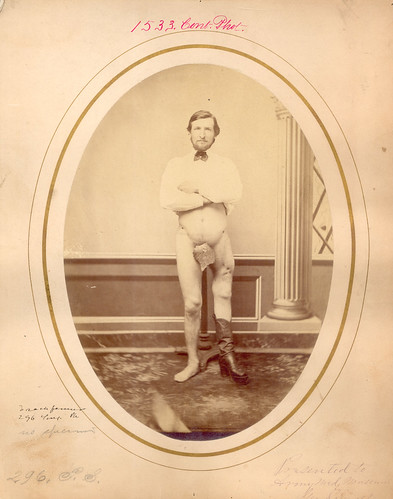
One day last week I sent you, by Express, a Tumor weighing 41 ½ pounds. It was taken from the abdomen of a man, after death. I made the post mortem for Dr. Brown of this city who promised to send me a history of the case on the following day. The Dr. called at my office last evening and said that he had been so buys in his practice that he had found no time to write the history but promised to see to it and send it to me this morning.

I have not yet received it, but will without doubt receive it in a day or two, and will then forwarded it to you with post mortem appearances.

This morning Hiram B. Smith, late Private 9th Co. Ohio Sharper Shooters called on me. He was a patient of mine at Armory Squa5e hospital suffering from gunshot fracture of the middle third of left femur. He was wounded Aug 19, 1864on the Weldon Rail Road – admitted at Armory Square Hopt. Aug 28th 1864 – transferred to Detroit, Mich. April 20th, 1865 and discharged from service at that Hospital (Harper) Nov. 11th 1865.
CP 1533
I have had a photograph taken and will send you a copy with a brief history in a few days.

Very respectfully
Your Obedient Servant
Geo. K. Smith
Late AA Surg U.S.A.

To Surgeon Gen. U.S.A.
Washington D.C.

P.S. The address of Hiram B. Smith is Weston Wood Co., Ohio. GKS

Sunday, February 21, 2010

Wash Post on Stabler-Leadbeater Apothecary Museum

Today's Washington Post has a photo feature on Alexandria's Stabler-Leadbeater Apothecary Museum.

Letter of the Day: February 21

This is what is more commonly known as a soap lady, like the one in the Mutter Museum in Philadelphia. Perhaps it’s the same one?

This letter was written 2 days before Otis died on the job.


Smithsonian Institution,

Washington D.C., Feb. 21, 1881


Dear Doctor,


I enclose an offer of an adipocere woman. Do you want it for the Museum. It ought to be preserved somewhere; but would not be appropriate for the National Museum


Yours truly,


Spencer Baird


Dr. George A. Otis

Medical Museum,

Washington, D.C.


Note on bottom says, “Enclosure returned to Prof. Baird”


Saturday, February 20, 2010

Vampires? Disease?

20 or so years ago, then-Anatomical Curator Paul Sledzik ended up doing some research on a burial that led him into looking into vampirism. Paul's a member of the blog, so I'll let him post on that if he wants, but it looks like some of his research is ending up in my friend Mark Jenkin's new book on vampires. Here's a short piece.

Letter of the Day: February 20

Apparently the Museum was taking x-rays a year after Roentgen discovered how to capture them.

Ballston, VA.
February 20, 1933.

Medical Museum
Washington, D.C.

Gentlemen:

About November 6, 1896, through a request of the Secretary of War, Dr. Gray made an ex-ray (sic) exposiure (sic) and several thereafter of my cranium, at which time there showed a foreign opaque, lodged in the brane (sic). It is desired to ascertain if there is a record of the circumstances and if possible to get a copy of the report.

This information is desired for use at the Capitol, by Dr. Copeland and Hon. Howard W. Smith of Congrss. The X-ray was again taken last week and they want to check on it.

Wm C Hammond

The letter sent back reads:

February 25, 1933

MEMORANDUM for Major Noyes, S.G.O.:

1. Enclosed herewith is post card from Wm. C. Hammond (Former 1st Cl. Apprentice, U.S. Navy, 701 E. Capitol St.) together with Photostat copies of the correspondence in re this case in 1896.
2. Inquiry by phone to the Record Dept., Bureau of Med. & Surg., U.S.N. and thru them to the U.S. Naval Hospital has fialed to add any further information.
3. We can find no record of the original films at the Museum.

V.H. Cornell,
Major, Medical Corps, U.S.A.
Curator

We no longer have any original correspondence, but there are 2 notes about the case. The longer one, dated November 12, 1896, reads:

Respectfully returned with 2 prints. The first negative (Print No 1) shows 2 inches backward in a straight line from orbital ridge and 5/8 inches upward from this point, on wounded side, a small triangular piece of metal, approximately 3/8 x 2/8 inches in its greatest diameters. This is believed to lie near the surface. The second negative (Print No 2) shows this piece of metal scarcely at all, but it shows distinctly a much larger piece in the posterior part of the head. Before making the last exposure two pieces of wire were tied together forming a cross; this cross was tied to the head of the wounded side and its position marked on the skin with nitrate of silver. The large piece of metal lies 6 34/ inches in a direct line backward from the crossed wire; its depth within the brain substance can only be determined by a photograph taken in the opposite direction.

Friday, February 19, 2010

Letter of the Day: February 19

Post Hospital

Fort McPherson, Nebraska.

February 19th, 1873


General:


I have the honor most respectfully too state that Private David Davis, Co. “K” 3rd U.S. Cavalry, committed suicide at this Post, on the 13th Instant, by shooting himself. The balls entered the Thoracic cavity severely lacerating the tissue of both lungs. I have preserved the pathological specimens, and, if they are of any value to the A.M. Museum, it will afford me  great pleasure to forward them, with a report of the case.


I have the honor to be,

General,

Your Most Obedient servant


J.H.T King

Capt. & Asst Surgeon, U.S. Army

Post Surgeon


To

Brig. Gen. J.K. Barnes

Surgeon General, U.S. Army

Washington, D.C.


A note on the reverse reads Specimens received April 5 1873, and acknowledged the same day.

Thursday, February 18, 2010

Letter of the Day: February 18 (2 of 2)

U.S.A. Post Hospital

Fort Griffin, Texas, Febr. 18th 1873


Asst Surgeon George A Otis

Curator A.M.M.

Washington D.C.


Sir:


Your communications dated Jan 22 & 23rd 1873 are at hand. In reply I have the honor to state that no specimens of value could be preserved from the bodies of Michael Murray “D”, 11 Infty and Michael Canan “E” 11 Infty.  Amputation of right index finger in the case of Chas. G. Kelly “C” 11 Infty, was performed previous to my arrival at this post. No specimen exist. (sic)


Very respectfully

Your Obedient Servant

E.A. Koerfoer

Asst Surgeon USA

Post Surgeon

Our scans on the Internet Archive

We’ve been busy uploading our scanned books to the Internet Archive and don’t often look to see how many times, or even if, anyone downloads them. Today we got an email from the Archive, saying that someone reviewed the logbook History of Specimens and Inventory of Specimen Preparation (MM 8761-1). A user named brewster gave us this nice review:


Subject: wonderful surprise book
In the open source collection there sometimes appears a surprising and wonderful book. For me, this is one of them. Hope you enjoy it as I do.


You can see everything we’ve uploaded so far by going to the Archive and searching for Otis Historical Archives.


Letter of the Day: February 18 (1 of 2)

Fort Garland, Colo.,

February 18, 1881


Surgeon General, U.S. Army,

Washington, D.C.


General –


I have the honor to transmit herewith the duplicate of a receipt from the Post Quarter-Master for certain pathological specimens, delivered to him for transportation to the Army Medical Museum, in the case of Musician Sylverster Obermeyer, Co. “D” 6th Infantry, who died here on the 9th day of January 1881.


Very respectfully,

Your obedient Servant,

A.I. Comfort

A.A. Surgeon, U.S.A.,

Post Surgeon


Enclosure filed “Receipts for Stores”


The specimen (Brain) with history turned over to Dr. Woodward – ack. Mch 25, 1881

Wednesday, February 17, 2010

King Tut's serious medical problems

Some nice paleopathology research reported here:
 
Published: February 17, 2010
The application of advanced radiological and genetic techniques to Egyptian mummies is a new step in the reach of historical inquiry through science.

OTIS HISTORICAL ARCHIVES 2009 annual report

OTIS HISTORICAL ARCHIVES  2009 annual report


STAFF:

            Michael Rhode, Chief Archivist

            Kathleen Stocker, Assistant Archivist

            (A) Jasmine High, Archives Technician

            Donna Rose, IMC Supervisor Archivist

            Amanda Montgomery, IMC Contract Archivist

            Johanna Medlin, IMC Contract Archivist

            Emilia Garvey, IMC Contract Archivist

            LaFonda Burwell, IMC Contract Archives Technician

            Karen West, IMC Contract Archives Technician

Anna Korosec, IMC Contract Archives Technician

            (A) Erissa Mann, student volunteer


Substantial requests for information were handled, frequently regarding sensitive topics. Of the requests that we tracked, we had at least 170 substantial reference requests this year, including from six countries outside the US. Rhode was interviewed by Alexis Madrigal for "Rare Trove of Army Medical Photos Heads to Flickr," Wired's Science blog and "Death Mask," a History Channel television documentary on Abraham Lincoln, and spoke on "The Army Medical Museum in World War I," American Association for the History of Medicine and "Graphic Tales of Cancer in America," History of Science Society (November 22 2009). Rhode and Stocker helped write the book Walter Reed Army Medical Center Centennial: A Pictorial History, 1909-2009. In addition to providing scans of photographs of the base and personnel, they also wrote captions while contributing to the layout and editing of the publication. The book featured many photographs from the Archives, but also new pictures of the base that Stocker took. Stocker and Rhode were listed as co-authors and presented with commanders coins for their work. Rhode has had a paper on cancer in comic strips accepted for the American Association of the History of Medicine's annual meeting in April. Tours were given to five formal groups, including the American Association of Pathological Assistants, the National Museum of Civil War Medicine, VCU School of the Arts, Elderhostel, and author Patricia Cornwell.
 
        The Medical Illustration Service Library, through the NISC (formerly IMC) scanning project, continues to be digitized.  Rhode is the Task Order Manager for the MIS part of the project; he and the assistant archivists and technicians selected material for scanning, reviewed the material, and recommended accepting the work on behalf of the government. Stocker and High provided the quality control.  The members of the NISC team are processing and cataloging the images prior to scanning so the records of the images are complete upon their return. 229,125 images were scanned last year, and this year is projected to be 400,000.   Collections scanned or added to the online system last year included HDAC's Carnegie collection photographs, New Contributed Photographs collection, the unpublished 7th Saranac Silicosis Symposium from the Vorwarld Collection,  Hollister Collection dental education photographs, an AFIP Study of 58 Combat Deaths from Vietnam, the Museum's Accession Files, the Museum's 19th century curatorial logbooks, John King's 35mm veterinary slides, 4 boxes of the AFIP Public Affairs Office photographs, the Spanish-American War photographic collection, WRAIR 1960s-1970s photographs (under a shared contract) as well as images of WRAMC from their DPW department and all of the historical images from the Navy's Bureau of Medicine and Surgery (BUMED). Thousands of 19th century Contributed Photographs and Specimen CDV scans were turned over to NISC and will be uploaded in 2010.
 
            Computerized cataloguing on the collection has continued on both the collection and item level.  Cataloguing of new material coming into the museum was done for the General Medical Products Information Collection, Medical Ephemera, New Contributed photographs, Audiovisual Collection, AFIP Historical Files, WRAMC Historical Collection and other artificial collections. Implementation of a comprehensive computer catalogue for the entire Museum continued with data from the archives added to KE Software's EMU database. New cataloguing is now done directly into EMU, unless a traditional archival-style finding aid is done.
 
New material acquired included a booklet of a photographic exhibit based on author Sarah Sudhoff's experience with cervical cancer; two handwritten class notebooks on physiology kept by Thomas A. McGrath, Sept 1906 to March 1907; one linear foot of letters and postcards relating to Dr. Luther B. Otken's WWI service with the American Expeditionary Forces; Pharmaceutical trade literature blotter cards; the large Archives of the American Board of Forensic Odontology; one notebook: The Physician's Perfect Call List maintained by RW Stoneburner, MD 1932-1936; papers, certificates, photos and items associated with the service of Col James L Hansen, former AFIP director; seven printed WWII-era malaria education cartoons by Frank Mack, consisting of three calendar pages from 1944 and four comic strips of Malaria Moe and Skeeter; a collection of Dr. George Ellis Mills related to the study and treatment of tuberculosis; the Goodman-Ishak Liver Pathology 35mm Slide Collection of  208 notebooks of 35mm liver pathology slides sorted by subject that were created by Dr. Kamal Ishak and Zach Goodman and arranged by Goodman; a print A Time for Healing by Robert M. Nisle, from a limited edition 1077/1120 and  signed by the artist that was printed in commemoration of the 50th anniversary of WWII; a slide collection of GI Pathology and material used to help set up a cancer registry in Afghanistan by Dr. Leslie Sobin and two artworks by Bryn Barnard from his Outbreak exhibit.
 
The Archives has a significant presence on the Internet including the Guide to the Collections of the Museum on the museum website which remains the main way researchers begin to use the archives. Stocker has revamped the Guide for the first time since 1998 and has put it on the web. Several finding aids were added to the website.  Stocker did finding aids for the Ball, Otken, and Registry of Noteworthy Research in Pathology collections. No more archival collections were listed in the Library of Congress' National Union Catalogue of Manuscript Collections (NUCMC); however, finding aids should still be sent to NUCMC in the future for the different audiences it reaches.
 

In fall 2006, archives staff began adding interesting photographs to Flickr's website. By late January 2008, approximately 400 photographs had gotten 48,000 views; in January 2009, 683 images had received 107,526 views, an increase of about 155%. On December 31, 2009, we wrapped up the year with slightly under a million views - 906,255 for approximately 1800 images. WRAMC continues to block access to Flickr so any additional photographs are added by staff from home. The Archives also received an invitation to join the Flickr Commons, a site for displaying the public photo collections of cultural institutions, which would increase viewership into the millions, but this has been waiting Legal Counsel's review for several years. A Repository for Bottled Monsters, an unofficial blog for the museum, continues to attract a worldwide audience. Because WRAMC blocks access to the blog, all posts to it are added by staff from home in their own time.

Books and documents scanned by IMC were uploaded to the free Internet Archive, where they are available for downloading. Titles uploaded by Stocker included a film Red Cross Work on Mutilés at Paris, 1918, a compilation of Atomic Bomb film footage (1945), the never-published Proceedings of the Seventh Saranac Symposium on Pneumoconiosis from the Vorwald collection, an issue of Carry On from 1918, and a World War 1-era Clinico Motion Pictures Catalog.
 
Rhode served on the AFIP's Institutional Review Board and HIPPA committees as well as Museum committees including the Admin group, the collections committee (as did Stocker), and the database committee (as did Stocker). Volunteering to do so, Stocker photographed parts of collections for use in the museum's newsletter, for exhibit production, and for uploading to the Internet Archive, and has photographed both in-progress and completed exhibits.
 

            Research and historical material, mostly on military medicine, was provided to AFIP, especially the Public Affairs Office for which High in particular has pulled scores of photographs for a new history of the AFIP. External users were from Italy, Israel, Japan, Australia, Germany, and England and included the following institutions: University of Southern Alabama, Columbia University, National Naval Medical Center, Museum of Science and Industry, National Institutes of Health, Travel Channel, Goethe-Universität Frankfurt, Mutter Museum, Fort Laramie National Historic Site, US Department of Health and Human Services, Ritsumeikan University, National Museum of American History, Duke University, Simon Frasier University, University of Oxford, Temple University, New York State Museum, Branch Health Clinic, History Channel, Wesleyan University, National Institute for the Humanities, Cornell University, National Archives and Records Administration, Ben Gurion University of the Negev, Stanford University, Wilmer Hale Law Library, Facts on File, Virginia Holocaust Museum, Baruch College, Iowa Methodist Medical Center, United Nations Office for the Coordination of Humanitarian Affairs, Yale University, Dickinson College, MIT Press, Kyodo News Chiba Bureau, San Juan College, Kent State University, WETA, Virginia Historical Society, Harvard University, University of Maryland, National Geographic Society, University of Chicago, Oakland University, National Health Service (UK), Artificial Eye Clinic of Washington, DC, Royal Botanic Gardens, Scholastic Library Publishing, University of California -San Francisco, Enslow Educational Publishers, Hiroshima Peace Institute, Hiroshima City University, Providence Journal, Science Photo Library (UK), American Society of Nursing, Discovery Channel, Trover Health System, OAH Magazine of History, New York Times, West Kentucky Community and Technical College, National Museum of Natural History, University of Texas Health Science Center, Slack, Inc.,  Jefferson Community & Technical College, Victorian College of the Arts, Centers for Disease Control and Prevention, and Mojave Desert Heritage and Cultural Association.


PUBLIC AFFAIRS REPORTS


1. Interview by Alexis Madrigal for "Rare Trove of Army Medical Photos Heads to Flickr," Wired's Science blog (March 17, 2009): http://blog.wired.com/wiredscience/2009/03/medarchives.html; on the same topic see also "Bringing Hidden World War II Photos to the Masses," By Betsy Mason, http://www.wired.com/science/discoveries/multimedia/2009/03/gallery_WWII_photos

2. On-camera interview by Wild Dream Films for "Death Mask," History Channel documentary on Abraham Lincoln, (interviewed February 6, aired October 26, 2009).


PRESENTATIONS


1. Stocker, K.  "Luther Otken, Surgeon, American Expeditionary Forces," National Museum of Health and Medicine (June),

2. Rhode, M. "The Army Medical Museum in World War I,"American Association for the History of Medicine (April 24),

3. Rhode, M and JTH Connor. "Graphic Tales of Cancer in America," History of Science Society (November 22).


PUBLICATIONS


1. Pierce, J, M Rhode, K Stocker et. al. Walter Reed Army Medical Center Centennial: A Pictorial History, 1909-2009, Washington: Borden Institute, 2009.