Pages

Saturday, August 16, 2008

Ford's Theatre renovation and reopening


A museum in Ford's Theatre is mentioned in passing in this article "The History Will Linger At Remade Ford's Theatre," By Michael E. Ruane, Washington Post Staff Writer, Friday, August 15, 2008; Page A01.

Ruane wrote, "The government bought the theater from Ford and used it over the years as a museum and as an office and storage building."

Well, that was the Army Medical Museum which was there for almost two decades, before it moved to a new bulding on the Mall (which was knocked down in 1968 for the Hirschorn). I wrote about the Museum there in Washington History (available from the Washington Historical Society) last year. Here's some relevant paragraphs edited down somewhat:

After President Lincoln's assassination in 1865, the federal government purchased and renovated the notorious Ford's Theatre to house the museum, the Surgeon General's Library, and the more than 16,000 bound volumes of the Records and Pension Division of the Surgeon General's Office. The move to Ford's Theatre in December 1866 permitted the museum to expand its collecting to include Native American weapons and “specimens of comparative anatomy.” Now the museum, with its larger exhibit space and broader scope, would become a well-known Washington-area landmark.

The museum had no difficulty attracting the public. Medical specimens, including many anomalies and curiosities, fascinated both lay and professional visitors alike. No doubt part of the fascination lay in the innate morbid curiosity of seeing human remains usually available in circus side-shows, but the Civil War had just ended, and the displays of specimens from maimed soldiers of both sides led visitors to see the museum as an unintentional national memorial. The glass cases of specimens were flanked by flags and standards of ambulances corps as well as Union and Confederate swords and sabers. While the displays were systematic, rather than artistic, they were nonetheless alluring, especially for thrill-seekers. A reporter for the popular Appleton’s Journal captured the atmosphere:

It is, indeed, not such a collection as the timid would care to visit at midnight, and alone. Fancy the pale moonlight lighting up with a bluish tinge, the blanched skeletons and grinning skulls — the same moon that saw, in many a case, the death-blow given, or the bullet pierce. The thought is not a comforting one, and those fancies would not be calculated, at such a time, to inspire courage. But in broad daylight, with the sun shining outside, and brightening up, with its tinge of life and activity, the tessellated floor, with the noise and traffic of the street outside, and the hum and murmur of numerous clerks and attendants inside, even those of timid proclivities do not then hesitate to inspect closely and with curiosity the objects which, twelve hours later, when the building is dark and deserted, they would scarce care to approach.

Opened to the public on April 16, 1867, the museum drew around 6,000 visitors by the end of the year. “It cannot fail to be one of the most absorbing spots on earth to the student of surgery or medicine,” opined guidebook author Mary Clemmer Ames in 1874, “but to the unscientific mind, especially to one still aching with the memories of war, it must remain a museum of horrors. . . . No! the Museum is a very interesting, but can never be a popular place to visit." In spite, or because, of Ames's concerns, by 1874, the number of visitors sometimes reached more than 2,600 per month, even the museum was only open from 10 am to 3 pm on weekdays, and on Saturday from 10 am to 2 pm. As early as 1866, the museum was well-known enough to be mentioned in Atlantic Monthly. In Dr. S. Weir Mitchell's fictional story, "The Case of George Dedlow," the hero, who lost both legs due to the war, was contacted by spirits during a séance. The spirits proved to be his amputated limbs, preserved in the Medical Museum: "A strange sense of wonder filled [Dedlow], and, to the amazement of every one, I arose, and, staggering a little, walked across the room on limbs invisible to them or me. It was no wonder I staggered, for, as I briefly reflected, my legs had been nine months in the strongest alcohol." Undoubtedly, readers of the story would have wished to visit the museum to look for the imaginary Dedlow's limbs.


As early as 1880, the Ford's Theatre building was proving inadequate for the expanding museum and library. In fact one exterior wall as falling away, and eventually the interior floors collapsed after the museum had moved out. In 1881 the museum attracted 40,000 visitors, while in 1888, the library had 5,000 readers. In his annual message to Congress, President Rutherford Hayes asked for an appropriation to replace the building. “The collection of books, specimens, and records constituting the Army Medical Museum and Library are of national importance. . . ,” Hayes wrote. “Their destruction would be an irreparable loss not only to the United States but to the world.”

Some congressmen opposed the idea of a new building, suggesting instead that the Army's medical records merge with the Pension Bureau's in their new building (now the National Building Museum), or amalgam the library with the Library of Congress and the museum with the Smithsonian Institution. Representative Clarkson Potter of New York objected on emotional grounds and opposed funding the museum and “preserving the relics and bones or wounds caused by the war at any place in our capital,” wishing instead that "they were all buried and covered all over with green grass and hidden from sight forever." On the other side, the more forward-thinking Representative Theodore Lyman of Massachusetts envisioned an institution something like today’s National Institutes of Health and "discern[ed] a hope that , , , germs may be used for inoculation and may protect us from . . . diseases, just as vaccination protects against smallpox.” Lyman deemed the museum’s studies “essential to the welfare of our people,” and the library “now the first in the world, and whose not less admirable collection of military pathology, are placed at the disposal of all investigators.”

The full article, "The Rise and Fall of the Army Medical Museum," has much more information in it of course.

To show that nothing really changes, we're currently scheduled to move off of Walter Reed Army Medical Center's DC campus due to the BRAC closure of the base, but no new home has been designated for us.

Ruane also wrote, "On the morning of June 9, 1893, the building was packed with 500 government clerks, occupying several floors of jury-rigged office space, when the interior collapsed, according to a Washington Post account the next day. Scores were killed and injured, and the theater's already altered interior was destroyed."

The space wasn't jury-rigged - actually it was built of cast iron, fireproof construction, but the space wasn't strong enough for all the tons of pension records that were being stored there.

Tuesday, August 12, 2008

Unknown

I was at Arlington National Cemetery Sunday morning when it opened so I could photograph the grave markers of the parents of a friend of mine from San Diego. She was able to come back for her dad's funeral in March but can't swing another trip to visit their grave. While I was there I wandered around and found the memorial that marks the graves of sailors and Marines who went down on the United States Battleship Maine in Havana Harbor in 1898.
The ship exploded and all hands, 229 of them, were lost. Seventeen years later their bodies were repatriated and buried in section 24 of Arlington, near the mast of the Maine. Their names are engraved on the foundation of the memorial.

A sad story in and of itself, but the most poignant part is when you walk among the tombstones and see this. Our Resolved exhibit shows how far we've come and made this kind of memorial obsolete.

Saturday, August 9, 2008

Another view of our Resolved exhibit


I think this is my favorite view of the exhibit. That's a transfer case draped with a flag and a backdrop from the Joint POW/MIA Accounting Command Forensic Anthropology Lab at Hickam AFB in Hawaii, showing the process of reconstructing human skeletons with the aim of identification. I always assumed it was a casket that brought our soldiers home, but it's not. The same grim purpose, a more utilitarian box.

Friday, August 8, 2008

Military medicine training article

Speaking of moulages and training, here's an article that talks about their current use. "Trial by (Simulated) Fire: Military Doctors Learn to Practice Wartime Medicine on Mock Battlefield," By Philip Rucker, Washington Post Staff Writer, Friday, August 8, 2008; B01. I met the doctor who's quoted at the end, Capt. Trueman Sharp, last year when the museum got a collection of Vietnam-era medical data from his department for scanning - the Wound Data Munitions Effectiveness Team (WDMET) records include wounding information, x-rays, 35mm slides and sometimes fragments. We've got the material being scanned now, but it's going to take a while to finish.

Wednesday, August 6, 2008

1918 flu comic for downloading


In my private life, I dabble in comic art history. Dave Lasky's done a comic book "No Ordinary Flu" about the 1918 influenza epidemic for King County in Washington State. You can download it as a pdf in multiple languages. Their website reads:

To promote pandemic flu preparedness, Public Health - Seattle & King County has developed a 12-page comic book on pandemic flu. Targeting readers of all ages, this story tells the tale of a family’s experience of the 1918 influenza pandemic. It also explains the threat of pandemic flu today, illustrates what to expect during a pandemic (such as school closures), and offers tips to help households prepare.

You can also hear Lasky on KUOW's Sound Focus for August 6th - "No Ordinary Flu and Recipes for Peaches." Here's a direct link.

Thanks to cartoonists Scott Gilbert and Scott Faulkner for the tips!

Is there any place for human remains in a museum (these days)?


Mike's post yesterday about a conference at which the title of this post will be discussed leads me to show you these pictures. They're all from our Resolved exhibit on identifying human remains. I'll show more pictures of the exhibit in future posts, but try to imagine the gaps if these body parts, out of squeamishness or political correctness, were no longer in our collection. Imagine our anatomical collections manager trying to explain, in words alone, how a female and male pelvis are different. Or what the mandible of a child of a particular age looks like (remember, no objects for illustration). Or the differences among the skulls of Europeans, Asians, and Africans. I'm still kind of new to the museum game as an employee, but as a long-time museum-goer, I think there's not a lot of place for this kind of question from museum professionals.

Tuesday, August 5, 2008

Human remains symposium in Paris text online

My colleagues at Biomedicine on Display caught this - International Symposium "FROM ANATOMIC COLLECTIONS TO OBJECTS OF WORSHIP". It dealt with human remains in museums, and the issues of repatriating them. The panels were as follows:

first round-table : repatriating human remains: why, for whom, under which conditions?
second round-table : Is there any place today for human remains inside museums?
third round table : the status of human remains from a legal, ethical and philosophical point of view
fourth round table : How to reach a mutual understanding? Institutional mediations and negotiations

Obviously the phrasing of the 2nd round-table just bugs me right away. Why shouldn't there be a place for human remains in a museum? I don't particularly care if mine end up there, and former museum pathologist Daniel Lamb insisted on it.

The whole text of the symposium is downloadable and I'm looking forward to reading it.

War Surgery in Afghanistan and Iraq featured by New York Times

This book, War Surgery in Afghanistan and Iraq, is by a friend of mine who's been working on it for several years. The book is in the grand tradition of the Medical and Surgical History of the War of the Rebellion which was also compiled to address problems of injuries during a war. It's published by the Borden Institute at Walter Reed where a lot of my friends and colleagues work as well - we're currently working on a photographic history of Walter Reed medical center for the 100th anniversary, right before they shut it down.

The article about the atlas of injuries is "To Heal the Wounded," By DONALD G. McNEIL Jr., New York Times August 5, 2008

There's also audio files linked to on the main page, as well as photographs.

Limb lab continuation - that Civil War amputee

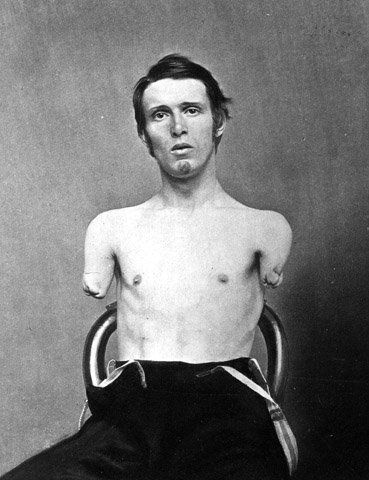
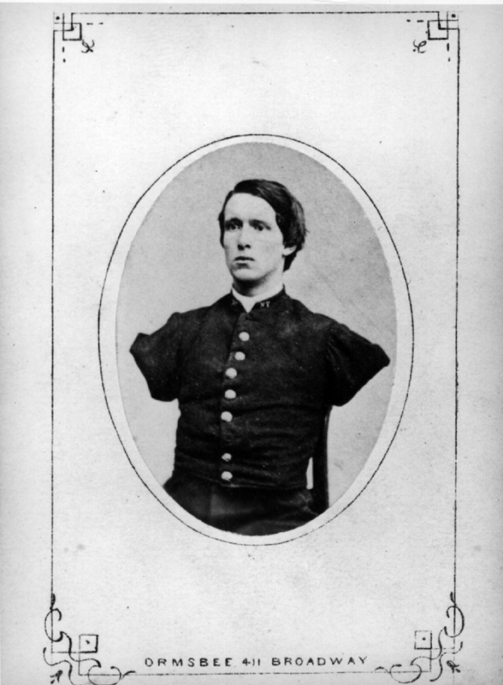
In a paper for Invisible Culture 5 - "Shooting Soldiers: Civil War Medical Images, Memory, and Identity in America," by J.T.H. Connor and Michael G. Rhode, we used Stratton's image. We noted, "After the war, disabled veterans used their photographs to support themselves in a variety of ways. Private Alfred Stratton took the most direct route. During the war, he endured a double amputation of both arms in 1864 and, as a result, received a pension of twenty-five dollars a month. In 1869, he visited the Museum and had his photograph taken. In later years, he sold carte-de-visites of himself in a uniform as a disabled soldier."

Here's the medical museum's photograph of Stratton:


And the cartes-de-visite Stratton sold to support himself:


This paper has pretty much everything I know about the Museum's Civil War photography and is one of my favorites of articles I've written.

Monday, August 4, 2008

Complicated grief

The Washington Post ran an article today about a condition called complicated grief. We have all had loss in our lives that we have grieved over but as deep as the grief is when fresh, over time it lessens. People who suffer from complicated grief don’t experience that lessening. A discovery that a part of the brain called the nucleus accumbens is activated by thoughts and memories of what was lost helps to explain this phenomenon. This part of the brain is associated with cravings and addiction, and in anticipating a reward. The theory is that those people who can't adjust to their loss are experiencing something pleasurable in their memories and "are addicted to the happy memories."

This discovery also explains why these people don't respond to traditional remedies for depression, which act on a different brain system involving serotonin. Scientists thing that a drug that acts on dopamine, which is involved with the nucleus accumbens, might be more effective.

Limb Lab presentation report at blog

Dr. Val Jones reported on Linker and Reznick's presentations a couple of weeks ago on her blog Revolution Health. I'll see if I can put up a picture of the Civil War amputee that sold the pictures of himself - his name was Alfred Stratton, I think.

Appalling practice by US hospitals reported by Times

This extensive investigative report must be read to be believed: "GETTING TOUGH: Immigrants Deported, by U.S. Hospitals," By DEBORAH SONTAG, New York Times August 3 2008.

Many hospitals are taking it upon themselves to repatriate seriously injured or ill immigrants because nursing homes won't accept them without insurance.

Surgeon General's Lecture Series at 1100 on 8 August 2008 in Memorial Auditorium, NNMC, Bethesda, MD

My buddy Andre sent this announcement about a lecture. I imagine you cant contact him if you need any additional information:

This is just a reminder that the Surgeon General's Speaker Series is set to continue on 8 August 2008 at 11:00 AM in Memorial Auditorium at the National Naval Medical Center, in Bethesda, MD. The lecture, "Jonathan Messersmith Foltz: Colorful Naval Surgeon and Friend and Foe of President James Buchanan," will be delivered by Ludwig Deppisch, MD, author of the recently acclaimed book, The White House Physician: A History from Washington to George W. Bush. This lecture will be open to all who wish to attend. As a note, this talk will hold special appeal to anyone interested in mid-nineteenth century American political and naval history. The subject of the lecture is a notable Victorian-era Navy surgeon who was linked to many famous literary, political, and scientific figures of his day including President James Buchanan, Admiral David Farragut, Samuel Morse, Edgar Allan Poe, and Queen Victoria. Dr. Foltz served as the first military White House physician, a Fleet Surgeon with Admiral David Farragut at the Battle of Mobile Bay, and in 1871 he was appointed as the Surgeon General of the Navy (becoming only the second person to hold that post).

André B. Sobocinski
Deputy Historian/ Publications Manager
Office of the Historian
Bureau of Medicine and Surgery (BUMED)
Tel: (202) 762-3244
Fax: (202) 762-3380
E-Mail: Andre.Sobocinski@med.navy.mil
http://navyhistory.med.navy.mil/

Moulage instruction booklet

As mentioned a couple of days ago, here's an instruction book for moulages meant to simulate mass casualties - Instructor's Guide for Casualty Simulation Kit Device 11E10

Friday, August 1, 2008

Mid-Atlantic history of medicine seminar

Since I'm on vacation, I can actually post to the blog during the day. Here's an announcement that Andrea wanted up:

Announcing the 6th Annual Joint Atlantic Seminar for the History of
Medicine, to be held the weekend of September 26-27, 2008, and hosted
by the Section of the History of Medicine and the Program in the
History of Science and Medicine at Yale University in New Haven, CT.
The seminar is organized and coordinated by graduate students across
North America working in fields related to the history of medicine.
Our mission is to foster a sense of community and provide a forum for
sharing and critiquing graduate research by peers from a variety of
institutions and backgrounds.

There is no fee for the Seminar, but registration is required.
The deadline for registration is September 10, 2008.

Please email Julia Irwin at JASMed2008@gmail.com to register.
For further information, see our website at www.jointatlantic.org

Wednesday, July 30, 2008

Establishing identity


Here's another shot from our Resolved exhibit. It shows the lines of evidence that must be explored in order to establish identity.
Forensic identification is the application of science to establish personal identity.
Postmortem data are an individual's physical characteristics recorded by scientists from a person's remains after death.
Antemortem data are the physical characteristics that a person is born with and acquires throughout life.
Identification results when a person's postmortem data matches an individual's antemortem data to the exclusion of everyone else.
Lines of evidence are those scientific disciplines that contribute to an identification, such as material evidence, fingerprinting, dentistry, anthropology, DNA, and pathology.
A case is resolved when an American returns alive, the remains are recovered, repatriated, and certified, or there is convincing evidence that neither of the two options is possible.

Tuesday, July 29, 2008

Neat article on why bacteria can make you sick

They group together and plot. See "Social Lives of Bacteria May Yield Benefits for Humans," By David Brown, Washington Post Staff Writer, Monday, July 28, 2008; Page A05.

Resolved


This image is what greets the visitor at the entrance to our new "Resolved" exhibit on identification of war dead. I think it's universal in language, eloquence without words.

Let's look at a photo

This one's for Johanna of the Morbid Anatomy blog - she's seen this picture before, but let's take a look at it.

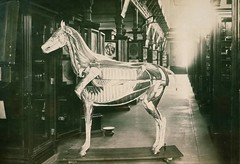
Reeve 00231 horse

Comparative anatomy, Auzoux model of horse, life size. Specimen no. 2635. [papier mache, on display in Army Medical Museum]. We no longer have the model, although one can be seen in the Science Museum in London.

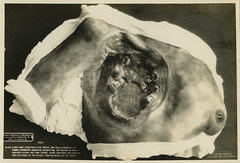
For many years, models were a way to convey information in medicine and natural sciences. Color printing had to be hand-done, and photography first didn't exist, and then each photograph for a book had to be printed individually and glued into the book. And hand-tinted if required. So well into the 20th century models like Auzoux's above, or ones like this x-ray burn were produced for education.

Reeve36721waxmodel_x-rayburn

Breast. Burn, X-Ray. Wax model. No. 92 X-ray burn involving right breast and axilla. Necrosis of tissue producing sloughing ulceration, the bottom of which includes pleura and lung tissue. X-ray treatment was applied for carcinoma of the breast. Colored, woman, age 35 years. Army Medical Museum model prepared by Dr. J.F. Wallis. [Circa World War 1, 1918].

The museum's model-making skills continued into the 1950s, when a technique called moulage, which simulated injuries in rubber overlays were developed. A soldier would put on a moulage of a nuclear radiation injury for example and then the trainees would attempt to treat him. I'll attempt to get some photographs of them up, although I think we scanned the kit's whole instruction book recently as well.

Check out this conference in Europe on models and Auzoux too.

Sunday, July 27, 2008

Memorial to French doctors


This relief is on an exterior wall at the Musée d'Histoire de la Médecine in Paris, kind of tucked away and probably not noticed much. I'm glad I found it. It's a memorial to the 1800 doctors who gave their lives for their country in World War 1.