
CP 1220 Captain JW Force, 22nd US Colored Troops.
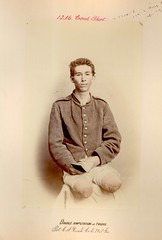
CP 1216 Confederate soldier Columbus Rush, 21st Georgia Volunteers
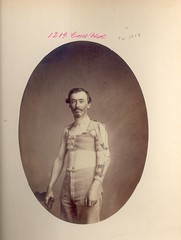
CP 1219 Corporal J.H. Jaxcox, 143rd New York Volunteers
UMBC anthropologist Seth Messinger recently began a new collaborative
arts-based research project exploring the everyday lived experiences of
people who wear prosthetics. An illustrated announcement is at
goo.gl/o4dRw <http://goo.gl/o4dRw> , and we invite you to post this on
the Bottled Monsters blog if you'd like, or to share it with your
colleagues
April 28 2011
http://www.nlm.nih.gov/news/apps_embryo.html
The US National Library of Medicine (NLM), the world largest medical library and a component of the National Institutes of Health, has released "Embryo" (http://itunes.apple.com/app/embryo/id422337604), a new app for the iPhone, iPod Touch and the iPad.
Embryo is a collaborative project between the NLM, the Eunice Kennedy Shriver National Institute of Child Health & Human Development (NICHD), the Virtual Human Embryo Project (Louisiana State University/ http://virtualhumanembryo.lsuhsc.edu/) and the National Museum of Health & Medicine's Human Developmental Anatomy Center (http://nmhm.washingtondc.museum/collections/hdac/).
The National Museum of Health & Medicine's Human Developmental Anatomy Center (HDAC) acquires and maintains collections pertaining to general developmental anatomy and neuroanatomy. Scientists and educators have used the National Museum of Health and Medicine's Carnegie Embryo Collection (http://nmhm.washingtondc.museum/collections/hdac/Carnegie_collection.htm) to define normal human embryo development for decades. This archival collection was developed between approximately 1887 to 1956 and focuses on normal development in the first eight weeks. The Virtual Human Embryo database was created to provide digital serial sections of human embryos from the collection.
The Embryo app provides this collection of digital serial sections of early stage human embryos for mobile devices. Features include human fertilization videos, photo micrographs of early-stage embryo development, 2D and 3D digital images using visual stack dissections, and a pregnancy calculator.
Leipzig, May 6, 1885
Dear Sir [John Shaw Billings],
I am much obliged to you for the sending of the photographics (sic) of crania. The methods of photographing several heads upon the same plate with scale of measure added appears indeed to be of great interest. I have shown these plates to Dr. Emile Schmidt (formerly in Essen), whose collection, embracing 1300 nos. is to be placed in our institution.
I have myself, I am sorry to say, little time for craniological studies, as all my free time is devoted to embryology, but whenever I can help to promote craniology, I do so with pleasure. With regard to the specimens Prof. Braun (spelling?) has already written to you, I presume, that he had made for you a series of sections, ready to be forwarded, simply waiting for your directions. The sudden death of our dear president Panum has undoubtedly grieved you. He was in the position which he filled with so much conscientiousness, as if made for it and would have assisted you in the organization of the Congress in 1887, with his advice.
Very respectfully
W. His
Smithsonian Institution,
Washington, D.C., May 5, 1880.
Dear Doctor Otis,
Charles Ruby, Private Co. D, 4th Infantry, Fort Laramie, says that while out between Hat Creek + Red Cloud Agency he passed the spot where the Cheyenne Indians two years ago made their last stand + nearly all were killed. He remarks that their skulls + bones lie scattered in all directions + will soon be lost. The thought occurred to him whether it would not be of interest to have some of these skulls collected.
Having called your attention to this subject, I remain,
Sincerely yours,
SF Baird
Dr Geo. A. Otis
Army Medical Museum.
Washington
Memorandum (written on reverse)
See letter of Dr. Carlos Carvallo, U.S.A., dated May 14, 1880, who states that as soon as possible he will go with a small detail in search of the skulls etc., alluded to within.


