Camp Letterman Hospital
Gettysburgh (sic) Pa, Sept. 12th 1863
Sir
Yours of the 11th is just received. As a general rule Medical Descriptive Lists have not been forwarded with patients sent to Baltimore and Philadelphia because, except those transferred by special order, nearly all those recently sent have been well or so nearly well that their Surgical histories could be completed. When cases terminate the histories are classified and compiled in a book ruled like the enclosed form. I was intending to forward the lists to you as soon as this was done; but you will save yourself a great deal of labor if you will wait until the compilation is done. You have no idea how difficult it has been to get even such poor histories as those I send to day. I have approved Dr. McArthur to attend to the compilation and have directed him to send the lists back unless they were tolerably satisfactory, in many cases this has been done several times before any thing of the least use could be obtained. Many of the Medical officers who have been relieved have left no records behind or records so imperfect as to be useless.
At the time your keg of whiskey was received there was no whiskey at the dispensary to I exchanged it for alcohol. We are now saving a considerable quantity of postmortem specimens, mostly injured bones and joins. Some cheap spirits for their preservation would be acceptable.
Except in very rare instances no capital operations are now performed.
It will be impossible for me to make a report and tabular statement of all the gunshot wounds for the month of July. On the 27th of May Dr. Letterman ordered that the monthly reports of the different corps hospitals should be made through the Medical Directors of the Corps to him. I suppose the reports for July were forwarded accordingly. At that time I had not sufficient clerical assistance to do my ordinary every day business, much less to consolidate the tabular statements.
The Corps registers have been copied and the names arranged alphabetically; except the registers of the 6th and 12th corps, none were complete, and that of the 1st Corps containing, according to Dr. Ward the Surg. in charge, 2200 names was taken to the [illegible], contrary to my orders, before it was copied.
As soon as the men are sufficiently recovered to need no further surgical treatment we send them off; the Union men to Philadelphia and the Confederates to Baltimore; very few, if any, will be able to serve in the field again.
Respectfully
Your obt. servt.
Henry James
Surg. U.S.A.
Surg J. H. Brinton U.S.A.
Sunday, September 12, 2010


Saturday, September 11, 2010
Letter of the Day: September 11
Certified list of articles contained in one package, turned over to the Post Quartermaster for shipment to the Surgeon General U.S.A.
No of packages and how marked
One package.
Marked:
Surgeon General U.S.A.
Washington, DC.
For Army Medical Museum
Contents
One kidney (human)
One bladder (“)
How packed
Air tight tin box enclosed in a wooden box
I certify that the above list is correct.
Henry S. Haskins
Actg Asst Surg. U.S.A.
Post Surgeon
Camp Halleck Nevada
September 11, 78
No of packages and how marked
One package.
Marked:
Surgeon General U.S.A.
Washington, DC.
For Army Medical Museum
Contents
One kidney (human)
One bladder (“)
How packed
Air tight tin box enclosed in a wooden box
I certify that the above list is correct.
Henry S. Haskins
Actg Asst Surg. U.S.A.
Post Surgeon
Camp Halleck Nevada
September 11, 78
Friday, September 10, 2010
New World War 1 scrapbook donated to Archives
Here’s information on one of our latest acquisitions – a really interesting scrapbook from the Great War.
Guide # OHA 213.5 Leach Scrapbook
Album of photographs of World War I facial case reconstructions and other surgical injuries. Dr. Charles Leach Sr. was born July 2 1884, and got a BA in Chemistry and an MD from Stanford University. He interned at San Francisco General Hospital in 1910. He joined the Commission for Relief in Belgium in 1916, then the US Army Medical Corps in 1917. From 1919-1920, he worked for the American Relief Administration. In 1920-1921 he earned a MPH from Johns Hopkins and after that joined the Rockefeller Foundation. For the rest of his career, he worked in public health. Dr. Leach died in 1971.
Letter of the Day: September 10
Jarvis
U.S. Army General Hospital,
Late Steuart’s Mansion,
Baltimore, Md., Sept. 10th, 1863
Sir:
I have the honor to enclose herewith the histories of six specimens, which have this day been sent by Adams + Cos Express Co. to the Surgeon Generals Office.
I am Sir,
Very Respy
Yr Obdt Servt
DeWitt Peters
Asst Surgn USA
Sugn J.K. Barnes
Surgeon Genl USA
Washington DC
Thursday, September 9, 2010
Letter of the Day: September 9
United States National Museum
Under Direction of
The Smithsonian Institution
Washington Sept. 9. 1886
Dear Sir:
I venture to request that you will lend me, for a few days, the mounted skeleton of Logenorhynchus acutus [aka Atlantic white-sided dolphin] in the Army Medical Museum. I have a paper on the genus Logenorhynchus in preparation and am desirous of comparing an authentic European specimen of the species referred to with others from our own Atlantic coast in this museum.
If you find it possible to grant my request, I will arrange to send a wagon for the specimen.
Very respectfully
Frederick W. True.
Curator of Mammals
Dr. J.S. Billings, U.S.A. +c
Director, U.S. Army Med. Museum.
Washington
Answered by Dr. Billings in person Sept 11. 86.
Prof True sent for No 2489. Sect. Comp Anatomy Sept 11, 1886, + the specimen was delivered to the messenger.
Wednesday, September 8, 2010
Letter of the Day: September 8
The Hague, Holland
Sept. 8th 1886
Dr. John S. Billings,
Surgeon US Army
Washington, D.C.
Dear Sir,
Your letter of June 19th was duly received by me, but not sooner answered on account of your absence mentioned in it.
After due consideration, I think it better to renounce my possible appointment as a clerk of the Army Medical Museum, employed for special duty.
I am sorry the great uncertainty as to the time of my appointment, and the terms relating to it oblige me to take this decision.
Very respectfully
Dr. H. ten Kate
Tuesday, September 7, 2010
Smithsonian's physical anthropology staff in newspaper
Natural History Museum's Origins of Western Culture hall will close for a 3-year renovation
By Jacqueline Trescott
Friday, September 3, 2010; C01
http://www.washingtonpost.com/wp-dyn/content/article/2010/09/02/AR2010090204957.html
Letter of the Day: September 7
Indianapolis General,
Sep. 7th 1868.
Brvt Maj Genl. J.K. Barnes, U.S.A.
Surgeon General.
Sir,
I have the honor to acknowledge the receipt of a circular, headed, “Memorandum for the information of Medical Officers.”
I have in my possession the skull of a New Mexico Indian, which I know nothing of the history of, except that it was brought direct from there by Mr James B. Dunlap – deceased - + given to me.
The skull is at your service. Please inform me how I shall send it, if you wish to have it in your collectin.
Your Obt Servt,
F.S. Newcomer,
A.A. Surg, U.S.A.
Monday, September 6, 2010
President McKinley's nurses
According to the NY Times, President McKinley was shot today by anarchist Leon Czolgosz at the Pan-American Exposition in Buffalo, N.Y. in 1901. Here's a related picture from our collection.
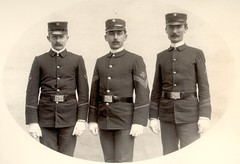
The Hospital Corps Men who served as the male nurses of President McKinley until his death. Private Ernest Vollmeyer, Acting Hospital Steward Palmer A. Eliot, and Private John Hodgins. Photographed at the Pan-American Exposition, Buffalo, NY, 1901. CP 2459
The Hospital Corps Men who served as the male nurses of President McKinley until his death. Private Ernest Vollmeyer, Acting Hospital Steward Palmer A. Eliot, and Private John Hodgins. Photographed at the Pan-American Exposition, Buffalo, NY, 1901. CP 2459
Letter of the Day: September 6
Dear Doctor:
I have been called upon to give testimony in a criminal case - in which there is a bullet wound of the head with extensive fracture of the skull – and no external marks of violence.
Would I be asking or troubling you too much in requesting you to send me such photographs as will have a bearing upon the case, such as will illustrate the average amount of fracture of the skull from bullets, + especially pistol shots.
Also such as will illustrate well authenticated cases of fracture from “Contre Coup.”
With great respect
I have the honor to be-
Very Sincerely,
Your Obdt Servant
A. Van Deveer
^^^^
Respectfully submitted to the Surgeon General, U.S.A. for instructions. A certain number of the illustrations contained in the Army Medical Museum on the subjects referred to have been photographed and prints have been furnished to two medical men of Albany, engaged in a medico-legal inquiry – possibly the same to which Dr. Van Derveer refers.
George A. Otis
Ass’t Surg. USA
SGO
Sept. 13. 69.
^^^^
Let him have them if in hand --
I have been called upon to give testimony in a criminal case - in which there is a bullet wound of the head with extensive fracture of the skull – and no external marks of violence.
Would I be asking or troubling you too much in requesting you to send me such photographs as will have a bearing upon the case, such as will illustrate the average amount of fracture of the skull from bullets, + especially pistol shots.
Also such as will illustrate well authenticated cases of fracture from “Contre Coup.”
With great respect
I have the honor to be-
Very Sincerely,
Your Obdt Servant
A. Van Deveer
^^^^
Respectfully submitted to the Surgeon General, U.S.A. for instructions. A certain number of the illustrations contained in the Army Medical Museum on the subjects referred to have been photographed and prints have been furnished to two medical men of Albany, engaged in a medico-legal inquiry – possibly the same to which Dr. Van Derveer refers.
George A. Otis
Ass’t Surg. USA
SGO
Sept. 13. 69.
^^^^
Let him have them if in hand --
Sunday, September 5, 2010
Letter of the Day: September 5
U.S.A. Post Hospital,
Fort Niagara, N.Y., September 5, 1879.
Asst. Surg. G.A. Otis, U.S.A.
Washington, D.C.
Sir:
In looking through one of the old volumes of the Medical History of the Post, I found this memorandum. These old relics are now in the Hospital Dead House. If you would like to have them sent on for the Army Medical Museum I will have them packed and turned over to the Post Quartermaster for transportation to you.
Very respectfully,
Your obedient servant,
William Wilson
Asst. Surgeon, U.S.A.
Post Surgeon
^^^^
Shot and Shell!
--+--
Relics of the Siege of Fort Niagara, N.Y., in 1759, -- fired by the forces of General Prideaux, and Sir William Johnson, --the Fort being held by the French.
These missiles were picked out of the old walls of the Fort when those walls were taken down, preparitory (sic) to the building of the present ones in 1843 and immediate subsequent years. The walls were of logs, set upright and with pointed logs or timbers projecting over the top.
These articles, several hundred points in weight in all, were in the keeping of the Engineer, Brevet Colonel Wilson, and Asst. Engineer, Mr. J. Lawrance, until sold at auction with other engineer property in the spring of 1874:
I procured these pieces of the purchaser at the time of sale.
John H. Bartholf,
Captain & Asst Surgeon, U.S.A.
Fort Niagara, N.Y.
September 1, 1874
The pieces alluded to above are pieced selected by Dr. Bartholf from those sold at auction + will weigh say about 40 to 50 lbs.
W. Wilson.
^^^^
The specimens were assigned number 1001, Sect 4, but then “These specimens were turned over to the Ordnance Department, October 3, 1879.”
Fort Niagara, N.Y., September 5, 1879.
Asst. Surg. G.A. Otis, U.S.A.
Washington, D.C.
Sir:
In looking through one of the old volumes of the Medical History of the Post, I found this memorandum. These old relics are now in the Hospital Dead House. If you would like to have them sent on for the Army Medical Museum I will have them packed and turned over to the Post Quartermaster for transportation to you.
Very respectfully,
Your obedient servant,
William Wilson
Asst. Surgeon, U.S.A.
Post Surgeon
^^^^
Shot and Shell!
--+--
Relics of the Siege of Fort Niagara, N.Y., in 1759, -- fired by the forces of General Prideaux, and Sir William Johnson, --the Fort being held by the French.
These missiles were picked out of the old walls of the Fort when those walls were taken down, preparitory (sic) to the building of the present ones in 1843 and immediate subsequent years. The walls were of logs, set upright and with pointed logs or timbers projecting over the top.
These articles, several hundred points in weight in all, were in the keeping of the Engineer, Brevet Colonel Wilson, and Asst. Engineer, Mr. J. Lawrance, until sold at auction with other engineer property in the spring of 1874:
I procured these pieces of the purchaser at the time of sale.
John H. Bartholf,
Captain & Asst Surgeon, U.S.A.
Fort Niagara, N.Y.
September 1, 1874
The pieces alluded to above are pieced selected by Dr. Bartholf from those sold at auction + will weigh say about 40 to 50 lbs.
W. Wilson.
^^^^
The specimens were assigned number 1001, Sect 4, but then “These specimens were turned over to the Ordnance Department, October 3, 1879.”
Saturday, September 4, 2010
Letter of the Day: September 4
Curatorial Records: Numbered Correspondence 906
Sept. 4, 1895.
Mr. Nathan Joseph,
641 Clay Street,
San Francisco, Cal.
Dear Sir:-
Your letter of August 28th, addressed to Dr. J.S. Billings is received.
In reply I would say that the offer therein contained is respectfully declined, as the Army Medical Museum contains a certain number of the skulls described by you,-- sufficient for its purposes, and is not now in a position to enlarge in this line.
Very respectfully,
D. L. Huntington
Depty. Surg. Genl., U.S. Army,
In Charge of Museum and Library.
Sept. 4, 1895.
Mr. Nathan Joseph,
641 Clay Street,
San Francisco, Cal.
Dear Sir:-
Your letter of August 28th, addressed to Dr. J.S. Billings is received.
In reply I would say that the offer therein contained is respectfully declined, as the Army Medical Museum contains a certain number of the skulls described by you,-- sufficient for its purposes, and is not now in a position to enlarge in this line.
Very respectfully,
D. L. Huntington
Depty. Surg. Genl., U.S. Army,
In Charge of Museum and Library.
Friday, September 3, 2010
Letter of the Day: September 3
Curatorial Records: Numbered Correspondence 905
Health Department, District of Columbia
Washington, September 3rd, 1895
Dr. Walter Reed,
Curator, Army Medical Museum,
Washington, D.C.
Dear Sir:-
I send you herewith a dog killed on the 1st. instant and alleged to have had hydrophobia. If you can kindly arrange to make the necessary tests, I shall be greatly obliged.
Very respectfully,
Wm. C. Woodward M.D.
Health Officer.
Health Department, District of Columbia
Washington, September 3rd, 1895
Dr. Walter Reed,
Curator, Army Medical Museum,
Washington, D.C.
Dear Sir:-
I send you herewith a dog killed on the 1st. instant and alleged to have had hydrophobia. If you can kindly arrange to make the necessary tests, I shall be greatly obliged.
Very respectfully,
Wm. C. Woodward M.D.
Health Officer.
Thursday, September 2, 2010
Letter of the Day: September 2
War Department,
Surgeon General’s Office,
Washington, DC, Septbr. 2nd, 1870
General,
I have the honor to report that in obedience to instructions from the Adjutant General’s Office, dated September 1st, 1870, I have this day re-enlisted Hospital Steward Geo. A. Jones, to date from August 31st, 1870, and have ordered the steward to report in person, fro duty, to the Surg Genl.
I herewith resp. transmit a copy of his enlistment papers.
E. E. Townsend
Wednesday, September 1, 2010
Letter of the Day: September 1
Curatorial Records: Numbered Correspondence 1627
Fort Reno, Okla. Ter.
Sept. 1, 1896.
Dear Doctor:-
The photographs of the malarial parasite were duly received. If I do not hear from you to the contrary, I shall consider that you meant to have me keep them.
There were no cases of malarial fever during August at this post. But if I am again unable to find the parasite in a case which I feel certain from other evidence is malarial, I shall certainly take advantage of your very kind offer and send on some dried specimens.
With many thanks, I am,
Very truly yours,
Sam Q Robinson
Major Walter Reed,
Surgeon, U.S.A.
Army Med. Museum.
Tuesday, August 31, 2010
PR: National Library of Medicine Announces "History of Medicine Finding Aids Consortium"
What a great project.
National Library of Medicine Announces “History of Medicine Finding Aids Consortium”
The History of Medicine Division of the National Library of Medicine (NLM) is pleased to announce the release of its prototype History of Medicine Finding Aids Consortium (http://www.nlm.nih.gov/hmd/consortium/index.html), a search-and-discovery tool for archival resources in the health sciences that are described by finding aids and held by various institutions throughout the United States. A finding aid is a tool created by archivists to give information about the contents of archival collections. Finding aids provide contextual information about collections oftentimes with detailed inventories to help researchers locate relevant materials. NLM is the world’s largest medical library and a component of the National Institutes of Health.
The resource crawls existing Web content managed by several partner institutions, provides keyword search functionality, and provides results organized by holding institution. Links point to the holding institution’s Web sites. Formats indexed consist of HTML, PDF and Encoded Archival Description XML. The project does not include content held in bibliographic utilities or other database-type information.
Crawls are conducted monthly to ensure information is current and to capture new content as it is released.
Current Consortium partners are:
- NLM History of Medicine Division, Archives and Modern Manuscripts Program
- Columbia University Health Center Library Archives and Special Collections
- Medical Archives of the Johns Hopkins Medical Institutions
- University of California-San Francisco Library Archives and Special Collections
- University of Virginia Health Sciences Library Historical Collections
- Virginia Commonwealth University Tompkins-McCaw Library Special Collections and Archives
NLM’s History of Medicine Division invites libraries, archives and museums which include in their collections archival materials related to the history of medicine and health sciences to join.
For more information about the project or requests to join the Consortium, please contact John P. Rees, Archivist and Digital Resources Manager, NLM, at reesj@nlm.nih.gov.
Letter of the Day: August 31
Curatorial Records: Numbered Correspondence 1683
August 31, 1896
To the Surgeon General, U.S. Army,
Washington, D.C.
General:
I have the honor to report that during the month of August, 1896, I have been on duty in the Surgeon General’s Office, as Curator of the Army Medical Museum, in accordance with Par. 2, S.O. No. 153, dated Headquarters of the Army, Adjutant General’s Office, Washington, D.C., July 7, 1893.
Very respectfully,
Walter Reed
Major and Surgeon, U.S. Army,
Curator Army Medical Museum
Monday, August 30, 2010
Medical Effects of Atomic Bombs vol. 6 scanned and online
Here's the manuscript:
and the 1951 published version:
These scans are part of OHA 104 - Artificial Manuscript [Atomic Bomb Material]
1866 Catalogue of the Medical Museum scanned and online for download
Catalogue of the Medical and Microscopical Sections of the Army Medical Museum - Joseph Woodward & Edward Curtis
http://www.archive.org/details/CatalogueOfTheMedicalAndMicroscopicalSectionsOfTheArmyMedicalMuseum
Catalogue of the Surgical Section of the United States Army Medical Museum - Alfred A. Woodhull
Describes the American Civil War anatomical specimens, usually bone, in the Museum.
http://www.archive.org/details/CatalogueOfTheSurgicalSectionOfTheUnitedStatesArmyMedicalMuseum
Letter of the Day: August 30
Hayward & Hutchinson,
424 Ninth Street, N.W.
Elias S. Hutchinson.
Washington, D.C., August 30, 1888
Dr J. S. Billings
Dear Sir:
While appreciating your kindness in sending to us for estimate for a cremating furnace, but as it is so much away from our line of work we cannot give it the necessary to make a close competitive estimate + respectfully return the plans with this.
Truly,
Hayward & Hutchinson
Subscribe to:
Comments (Atom)